
The Evolution of Automation in the Wood Product Manufacturing Industry

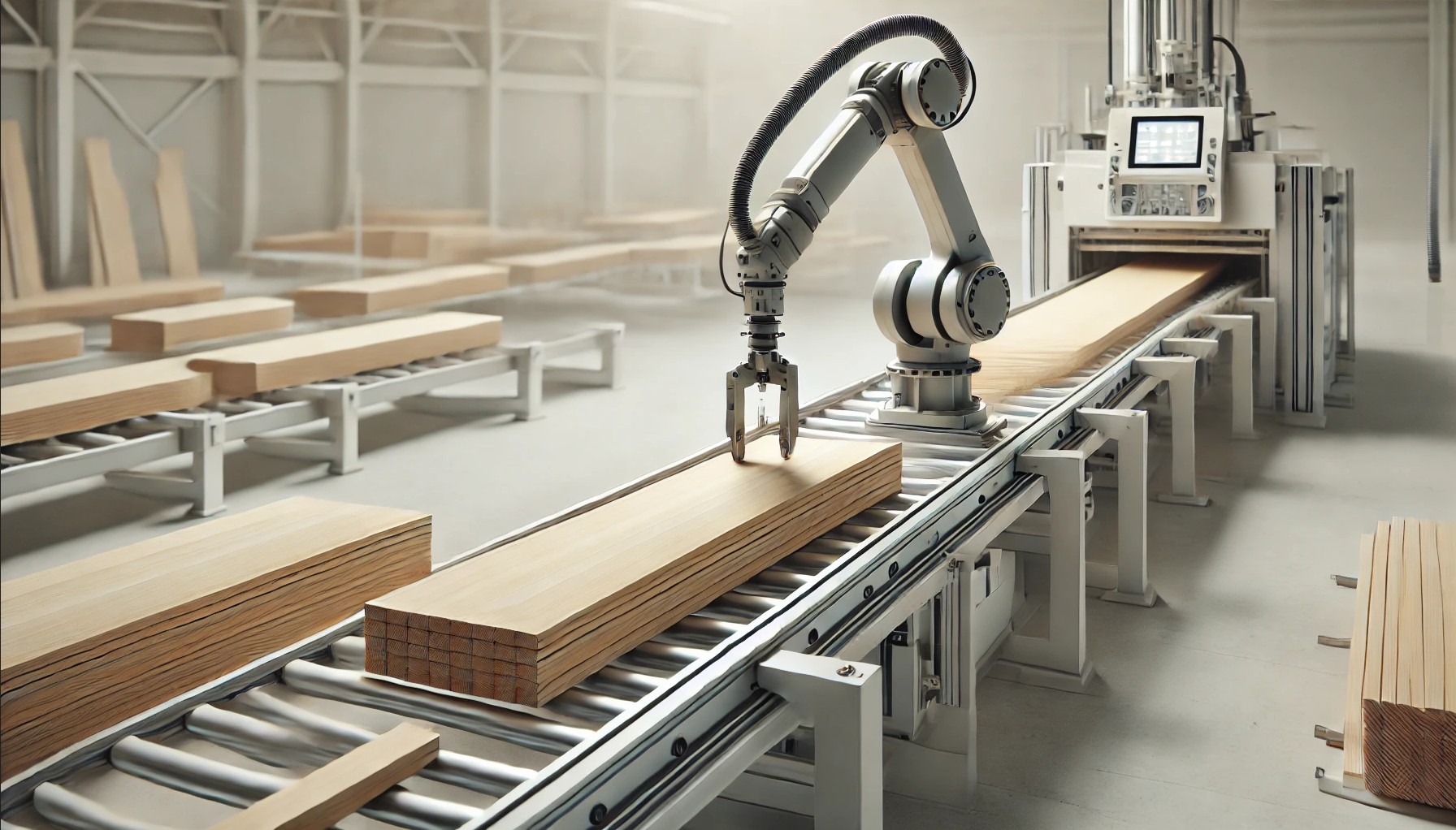
Wood industry automation has evolved rapidly over the past two decades. From robotic feeders and CNC nailing tables to vision-based quality control, technology that used to be reserved for the largest mills now reaches small and medium-sized producers across pallet, crate and plywood production. This article traces how that shift happened, which technologies actually moved the needle, and — more practically — in what order a producer should automate today.
From manual labour to automated lines — what actually changed
Through the 1990s, a typical pallet or crate plant ran almost entirely on manual labour: operators fed boards by hand, positioned them on jigs, nailed with pneumatic tools and stacked finished units at the end of the line. A good two-person team could assemble 120–180 pallets per shift this way — with output falling visibly toward the end of the day as fatigue set in.
Three developments changed the economics. First, servo-driven nailing bridges made machine cycle times consistent — a nailing line today holds 6–9 pallets per minute for an entire shift, roughly ten times manual output with a fraction of the crew. Second, industrial robot arms became affordable for mid-sized plants: a task like feeding deck boards to a moulder or stacking finished pallets, once a full-time physical job, is now a standard robotic application. Third, programmable controls (PLC and later CNC) meant a format change stopped being a mechanical re-rigging job and became a recall of a stored program.
The four technologies that did the heavy lifting
1. Robotic feeding and stacking
Feeding raw boards and stacking finished product are the most repetitive, injury-prone stations on any wood line — and the first place robots earned their keep. A robotic feeder and stacker arm works both ends of a moulder without breaks, holding a steady rhythm the machine downstream can rely on. Consistent infeed alone often recovers 10–15 percent of nominal line throughput.
2. CNC-controlled nailing
Fixed-jig nailing lines are fast but inflexible — profitable only with long runs of a single format. CNC changed that equation: a CNC pallet nailing table stores pallet formats as programs, so a plant serving many customers with varied formats can switch in minutes instead of hours. This is the technology that made short-run custom pallets economically viable for smaller producers.
3. Inline quality control
Manual inspection catches defects late — usually after the customer complains. Sensor-based systems moved that check into the line itself: a protruding-nail detector flags a mis-driven nail the moment it happens, before the pallet reaches a stack or a customer’s automated warehouse, where a single protruding nail can stop a conveyor.
4. Automated sorting and handling
The pallet recycling sector adopted automation on its own path. Grading used pallets by hand is slow and inconsistent; an automated pallet sorting line unstacks, inspects, flips and routes each unit to repair or dispatch — turning a yard job for four workers into a supervised process for one.
What automation looks like on a real production floor today
A modern automated pallet plant connects these pieces into one flow. Sawn timber enters a crosscut station; boards feed automatically to the nailing line; the finished pallet passes a nail detector; a stacker builds dispatch-ready piles; and in recycling operations, returned pallets run through the sorting line to be graded and routed. Each machine removes one manual station, and each removed station takes its variability — fatigue, absence, injury risk — out of the line’s output equation. We walk through complete line configurations on our pallet automation and robotics page.
What to automate first — a practical order of investment
Producers rarely automate everything at once, and full-line projects are not where most should start. The pattern we see work:
- Fix the bottleneck, not the showcase. Measure where pallets-per-hour actually dies — often the infeed or the stacking end, not the nailing bridge itself.
- Automate the stations that injure people. Feeding and stacking carry most of the strain injuries; they are also the easiest robotic applications with the clearest labour savings.
- Add inline QC before adding speed. A faster line that ships defects just ships defects faster. Detection equipment is inexpensive relative to one lost customer.
- Go CNC when your order book is varied. If you run one format all year, a traditional line wins. If you juggle formats weekly, format-change time is your hidden cost.
For the financial side of this decision — payback periods and the production volumes where each path makes sense — see our analysis of pallet automation ROI.
Where wood industry automation goes next
The near future is less about new robots and more about smarter existing ones. Predictive maintenance — sensors flagging a bearing before it fails — is moving from sawmill giants down to mid-sized plants. Vision systems are getting better at grading timber quality at infeed, which attacks the single most common cause of automated-line stoppages: bad boards jamming good machines. And format data increasingly flows directly from customer order systems to CNC equipment, removing the last manual translation step.
None of this changes the fundamentals. Automation in wood manufacturing pays back where it removes a measured constraint — a bottleneck, an injury-prone station, a quality escape — and disappoints where it is bought as a showcase. The producers who get it right start with the measurement, not the machine.
Evaluating an automation step for your own line? Talk to our technical team — we supply new, used and refurbished equipment and can help match the machine to the actual constraint.