
The 4 Hidden Bottlenecks Slowing Your Pallet Line (And How to Diagnose Them in One Shift)

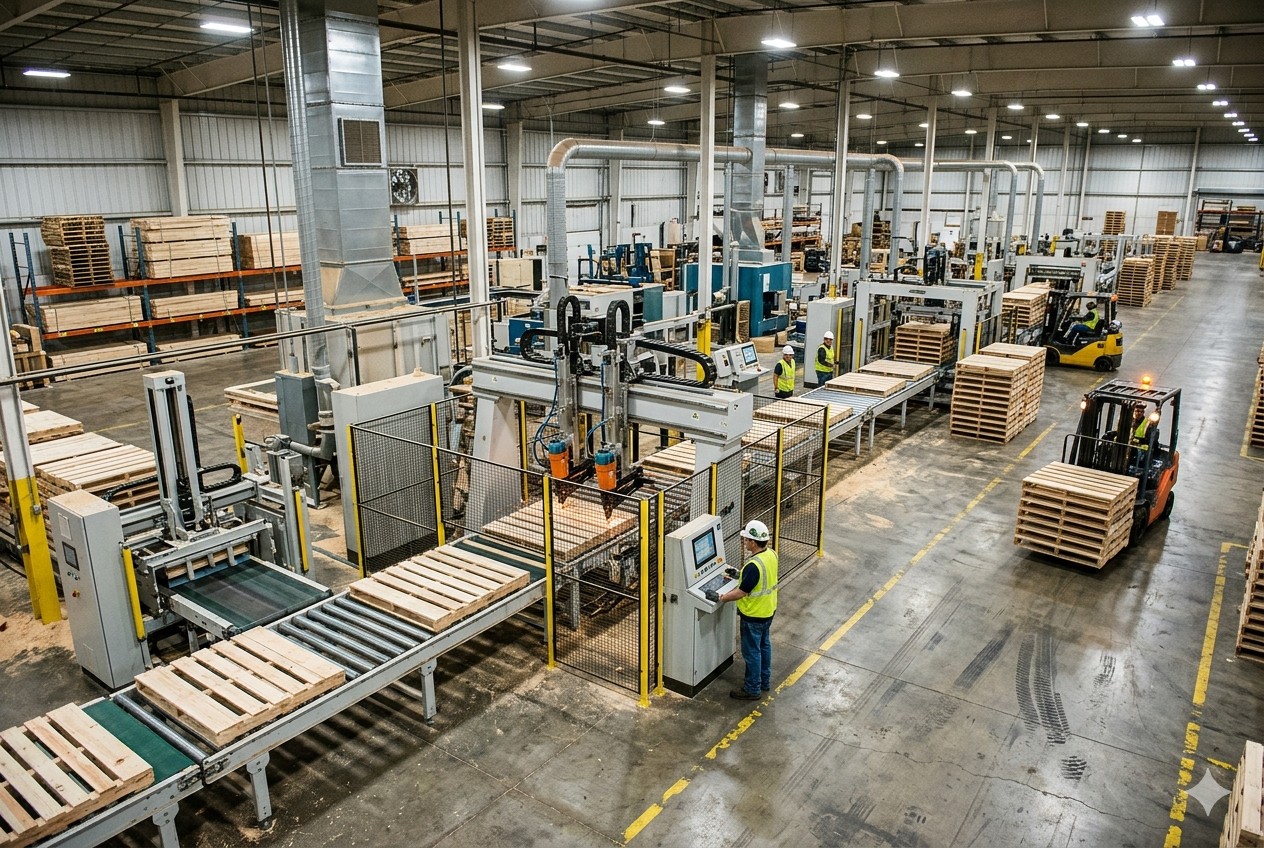
Pallet producers rarely identify the real pallet line bottlenecks that keep their lines from running at the throughput stamped on the manufacturer’s spec sheet. The gap is usually 30 to 40 percent — a difference that quietly costs a busy plant tens of thousands of euros a quarter in lost output. The frustrating part is that the cause is rarely obvious from the operator panel. By the time the morning shift ends and somebody crunches the numbers, the day is already lost.
This article walks through the four pallet line bottlenecks that account for most of that throughput loss on industrial nailing lines, plus a couple of secondary ones worth checking. Each is diagnosable in a single shift, with no investment beyond a clipboard and an attentive eye.
1. Wood quality — the most common pallet line bottleneck
The single most common reason a feeder or automated transfer keeps stalling is not the machine — it is the lumber going into it. Boards with excessive bow, twist, knots near edges, irregular thicknesses, or moisture pockets behave unpredictably inside feeders calibrated for clean, uniform stock. Each unexpected jam is a 5-to-15-second stop, and on a busy line those compound across thousands of cycles.
How to diagnose: for one shift, count the number of jam-related stops and compare against a shift where the lumber batch is known to be high grade. If the difference exceeds 8 to 10 stops per 1,000 pallets, your incoming lumber spec is too loose for what your feeders were designed to handle. The fix is rarely a feeder upgrade — usually a tighter pre-grading step or a quality clause with your lumber supplier.
2. Poor format adjustment — a hidden pallet line bottleneck
Modern pallet lines can produce different formats — EUR, GMA, custom dimensions — but only when the machine is correctly adjusted for the format being run. A misaligned guide rail, an off-spec nail position, or a stringer stop set 5 mm out of true will not visibly stop the line, but it will produce a steady trickle of rejects, manual touch-ups, and operator interventions that drag throughput down without ever showing up as a clear failure.
How to diagnose: measure 10 finished pallets at random against the spec sheet. If you find more than 2 dimensional or alignment deviations — even small ones — your line is configured wrong for the format. Each format change should be followed by a calibration check, not just a “looks right” visual confirmation.
3. Feeder starvation — upstream falling behind
A pallet line is only as fast as its slowest feeder. If your stringer feeder, top-deck feeder, or bottom-deck feeder is running below the nailing head’s rated cycle, the head sits idle waiting for material — what production engineers call starvation. Most producers don’t realise their nailing head is starved for 10-20% of every shift because the symptom isn’t a stop, it’s a pause — and pauses don’t show up on hour counters.
How to diagnose: watch the nailing head for 30 minutes during a normal run. Count the cycles where it pauses with no material in front of it. If that pause time exceeds 10% of total cycles, an upstream feeder is starving the line and that is your real bottleneck — not the head.
4. Stacker buffer saturation
The exit stacker is the silent throughput killer. If the downstream stacker fills its buffer before a truck or trailer is ready to receive, the entire line backs up. Some producers run their stackers at 90% buffer all day and never notice until they look at the cycle log — by which time the nailing head has been waiting in 15-second intervals for half the shift.
How to diagnose: pull the stacker cycle log and compare run-time vs idle-time. If idle exceeds 12% of shift time, the stacker is calling the shots, not the nailer. The remediation is operational rather than mechanical: tighter coordination with logistics, an additional staging area, or a buffer extension if the line layout allows it.
Two more worth checking
Air supply pressure drops. Pneumatic nailing heads are obsessed with pressure. A line designed for 7 bar that sees real-world pressure dipping to 5.5 bar during peak draw will misfire one nail in fifty — and every misfire is either a quality reject or a manual touch-up. Install a temporary pressure gauge directly at the nailer manifold and watch it during a full pallet cycle. If it dips more than 0.5 bar from idle, you have a sizing or restriction problem in the air line.
Personnel — staffing and training. Even a mechanically perfect line falls apart with the wrong people in front of it. An understaffed shift that leaves one operator covering two stations turns every minor incident into a stoppage. A poorly-trained operator does not know which adjustments to make when the line shows the early warning signs of any of the bottlenecks above. Productivity loss from staffing gaps and skills gaps is harder to measure but very real — often as much as 10% on its own.
Putting it together
Most pallet plants discover, when they actually instrument the line for one full day, that the throughput gap is split across two of these pallet line bottlenecks rather than caused by any single one. The good news is that none of them require capital investment to identify — just a clipboard, a stopwatch, and someone willing to spend a shift watching the line instead of running it.
Once you know which bottleneck dominates, the next question is usually whether it is recoverable through tuning or whether it justifies an equipment upgrade. Our companion articles on hidden pallet production costs and pallet automation ROI walk through exactly that decision.
How we can help
At Global Wood Machines we work with pallet producers across Europe, North America and the Middle East to identify and resolve exactly these pallet line bottlenecks. Whether the answer is a calibration adjustment, a feeder upgrade, a higher-throughput nailing line, or a fully integrated CNC nailing solution, we can specify the equipment and configuration that matches your real production constraints. Browse our pallet machinery catalogue to see the equipment options.
If you recognise your operation in any of the four pallet line bottlenecks above, get in touch with us — describe what you are seeing on the line and we will tell you what is realistic to fix today, and what would justify an equipment upgrade.