
Nails, Lumber, Downtime — The Three Hidden Costs Quietly Eating Your Pallet Margin

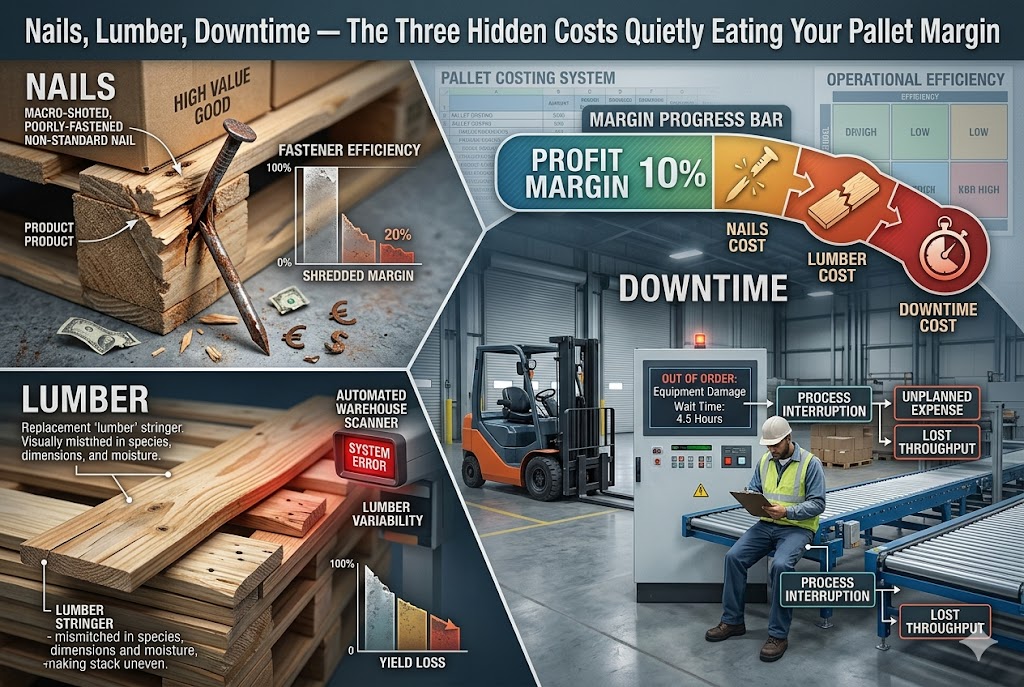
Hidden pallet production costs operate quietly inside the thin margins of pallet manufacturing. A typical 1,000-pallet-per-day plant runs at single-digit operating margins, which means the difference between a profitable shift and a loss-making one is often just a few percentage points of cost discipline. The three pallet production costs producers underestimate most — nail consumption, lumber waste, and downtime — together can quietly subtract 5 to 10 percent from margin every quarter without ever showing up as a clear line item.
Each of these hidden costs has a measurable signature on the production floor. Here is what to look for and what each one is realistically worth.
1. Nail consumption — the pallet production cost hiding in your purchase orders
The straightforward calculation says a stringer pallet uses around 78 nails. The real-world number on most lines is closer to 85-90 nails per pallet — a 9 to 15 percent overshoot that comes from misfires, double-strikes, jammed nail strips, and the small handful of nails the operator throws back into the bin during clean-up. A plant making 1,000 pallets a day at €0.012 per nail is leaking around €100 a day in nails it never used productively.
How to diagnose: compare your nail purchase volume per quarter against the theoretical consumption based on production output. If actual consumption exceeds the theoretical figure by more than 6 percent, you have a recoverable cost. The fix is typically a combination of pneumatic head adjustment, nail strip handling improvements, and better operator training on jam clearance.
2. Lumber waste — the cuts you don’t think about
Lumber yield in a pallet plant is rarely the rated 92 to 95 percent. Real-world yield often drops to 85 percent or below when crosscut residue, off-spec rejects, end-trim losses, and damaged-during-handling boards are all added together. On a plant consuming 100 m³ of lumber per week at €240 per m³, every percentage point of yield loss is worth roughly €240 per week — over €12,000 per year per percentage point.
How to diagnose: for one week, weigh or measure the volume of waste leaving each station — crosscut offcuts, reject boards, sweepings — and compare against the lumber input. If waste exceeds 12 percent of input, you have a yield problem. The remediation usually starts at the crosscut: smarter optimization of cut patterns, tighter input grading, and a separate channel for short offcuts that can be sold as biomass instead of being treated as scrap.
3. Downtime — the pallet production cost no one wants to measure
The cost of a stopped pallet line is rarely tracked. A line designed for 130 pallets per hour at €4 per pallet generates around €520 per hour of throughput value. Every hour of unplanned downtime costs that, plus operator wages, fixed overhead, and the missed delivery commitment that may need to be made up with overtime later. A typical busy plant accumulates 6 to 8 hours of unplanned downtime per week across all causes — a hidden cost of €15,000 to €20,000 per quarter.
How to diagnose: add a downtime tag to the production log for one month. Each event should record start time, end time, and root cause (jam, breakdown, material wait, format change, operator absence). At the end of the month, group by root cause. The biggest category usually points to a fix that pays back within weeks: a maintenance schedule change, a quick-change tooling investment, a feeder upgrade, or a staffing adjustment.
Putting it together
None of these pallet production costs is dramatic on its own. Each is a percentage point or two leaking out of the operation through processes nobody examines because the numbers feel “normal.” But added together — 9 percent on nails, 5 percent on lumber yield, an hour of downtime per shift — they routinely consume 5 to 10 percent of operating margin in plants that haven’t put deliberate measurement in place.
The good news is that all three are recoverable without capital investment. A clipboard, a stopwatch, and one disciplined month of measurement is enough to identify which of the three is your dominant leak. The bigger your operation, the more these hidden costs are worth in absolute euros. Our companion articles on pallet line bottlenecks and pallet automation ROI walk through the next decisions once you know your dominant leak.
How we can help
At Global Wood Machines we work with pallet producers across Europe, North America and the Middle East to spec equipment that targets exactly these hidden pallet production costs — nailing heads with lower misfire rates, optimized crosscut systems, and automation that reduces unplanned downtime from material-handling mistakes. Browse our pallet machinery catalogue to see the equipment options.
If you recognise these leaks in your operation, get in touch with us — share what you are seeing and we will tell you what is realistic to recover and what would justify an equipment investment.