Pallet Line Automation ROI — At What Production Volume Does It Actually Pay Back?

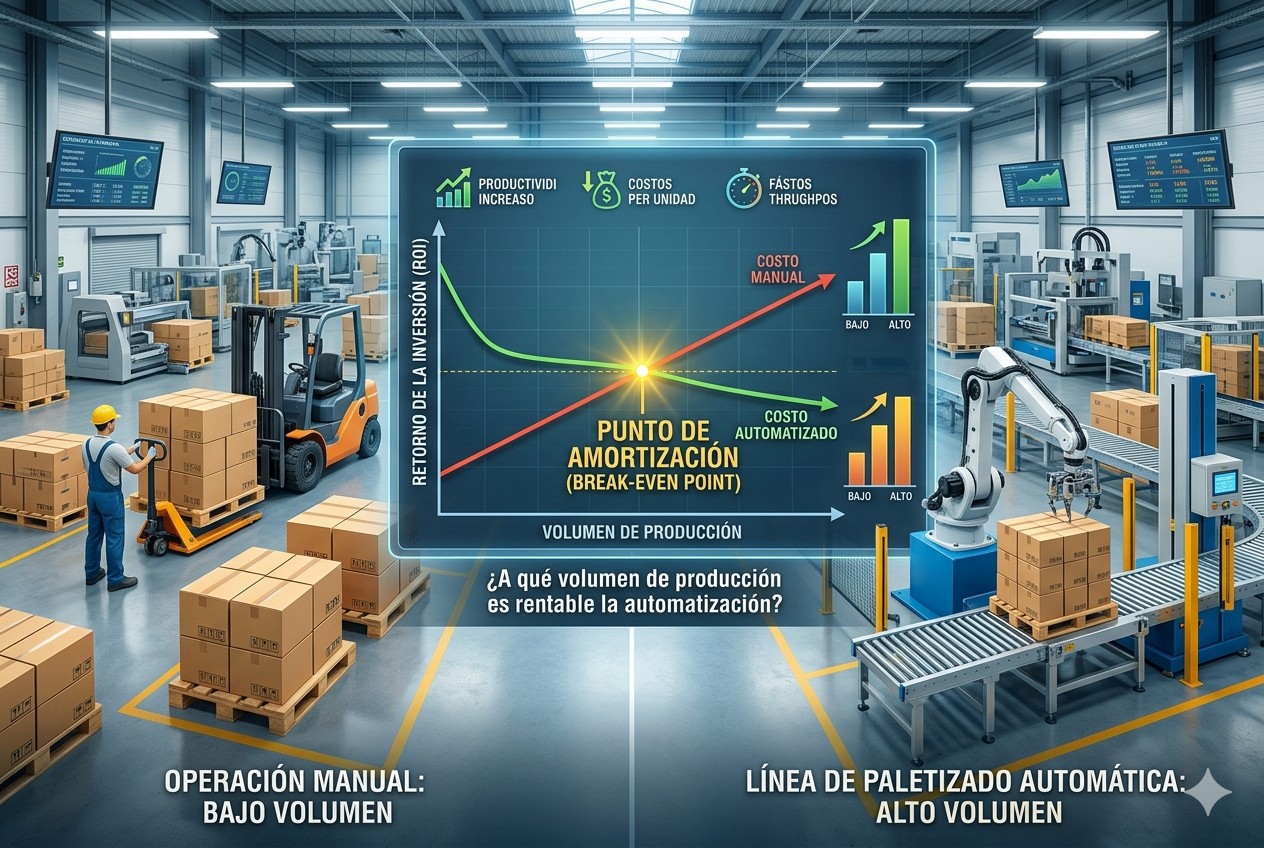
Pallet automation ROI is the most over-promised number in our industry. Equipment vendors quote 18-month payback periods that assume best-case throughput and labour savings the customer hasn’t actually verified. The real pallet automation ROI depends heavily on which type of automation is on the table — and what problem you are actually trying to solve.
This article walks through the actual ROI math for two distinct automation paths — automated loading on high-volume traditional lines, and CNC nailing tables for varied formats — and the operational conditions that decide whether the investment pays back.
Two automation paths, two different pallet automation ROI cases
Before any number can be useful, the conversation has to separate two very different machines that both get called “automation”:
Automated loading on a traditional high-volume line. A line nailing between 6 and 9 pallets per minute — roughly 360 to 540 pallets per hour — where the upgrade automates the manual loading of stringers and deck boards. Big throughput, narrow format range, narrow ROI conditions.
CNC nailing tables. A different machine entirely: typically 35 to 90 pallets per hour, designed specifically for varied formats and short production runs. The operator still loads the boards manually — it is the nailing pattern, the corner cutting, and (with robotic unloading) the discharge that are automated. CNC is the right answer when format mix is the operational reality.
The cost side: what you actually spend on a CNC line
A CNC pallet nailing line with robotic unloading lands in the range of €210,000 to €260,000 depending on the number of stations and configuration features. That headline number is most of the story. Add roughly 15 to 20 percent for installation, commissioning, and a brief training period; CNC operation is intuitive enough that a new operator typically reaches estimated production rate within one month, not three.
Most producers underestimate one additional cost: the production gap during installation. If your existing line shuts down for the changeover, you need to either build inventory ahead of time or accept a hit to delivery commitments. On a busy operation this can be worth €30,000 to €50,000 in opportunity cost.
The benefit side: what automation actually solves
Automation delivers a roughly 20 percent throughput gain over a tuned manual line — not the 50 to 60 percent some vendors promise. But throughput is rarely the real reason producers automate. The deeper reason, particularly in Europe and North America right now, is labour:
Hiring difficulty. Pallet plants compete for low-skilled labour against logistics, agriculture, and construction. In many regions the labour pipeline simply isn’t there, and unfilled positions on the line translate directly into missed delivery commitments.
Hidden labour cost. Beyond the hourly wage, employers carry severance liabilities (pasivos laborales), paid vacations, sick leave, and the productivity loss of physical injuries from manipulating heavy and non-ergonomically positioned elements over thousands of cycles per shift. These together add 30 to 50 percent on top of the hourly wage, depending on jurisdiction.
Ergonomic injuries. Manual pallet stacking is a chronic source of back and shoulder injuries. Each injury is an absence, a possible workers’ compensation claim, and the loss of an experienced operator the line was already optimized around.
The realistic payback period for automating the loading on a high-volume line, when the labour problem is the dominant motivation, is around three years.
Volume context — the key pallet automation ROI nuance
Production volume is more relative than vendors usually present it. A CNC nailing line nailing 40 pallets per hour on a single shift, working with varied formats, can be a highly profitable investment — even though 40 pallets per hour sounds modest next to a high-volume traditional line at 6 to 9 pallets per minute.
The distinction is operational: a high-volume traditional line is built for repetition; a CNC line is built for flexibility. The pallet automation ROI question is not “does automation pay back at X pallets per year?” — it is “which machine matches the operational profile of my plant?”
When automation does NOT make sense
Demand is genuinely uncertain. If your three-year forecast has high variance, locking in a fixed asset against an uncertain pipeline transfers risk you may not want. This is the one condition where pausing the automation conversation is genuinely the right call.
Two conditions that often get raised but in practice are not barriers:
Variety of formats. Frequent format changes are exactly where CNC shines. If you produce 20+ pallet formats, CNC is more often the answer than the problem — rapid format change is its core competitive advantage versus a high-volume traditional line.
Inconsistent lumber supply. This is a real problem for high-volume automated loading lines, where a single off-spec board can stop the feeder. CNC absorbs the irregularity, because the manual loading step lets the operator filter problem boards before they reach the nailing head.
Putting it together
The right question is rarely “should we automate?” — it is “which automation matches our operational profile?” A high-volume plant with stable demand and stable lumber supply is the textbook case for automated loading. A plant facing labour shortage, varied formats, or inconsistent lumber is the textbook case for CNC. A plant with uncertain demand should optimize the existing manual line first. Our companion articles on pallet line bottlenecks and hidden pallet production costs walk through the optimization side.
How we can help
At Global Wood Machines we help pallet producers separate the pallet automation ROI conversation from the vendor-promise conversation. We offer honest assessments based on your actual numbers — production volume, format mix, lumber supply, labour situation, demand pipeline — and recommend the equipment configuration that matches your operation. Browse our pallet machinery catalogue for the equipment options.
If you are evaluating automation, get in touch with us — share your production figures and constraints and we will run the math against the equipment options that fit your reality.