
The Lifespan of a Wooden Pallet: How Long Does It Really Last?

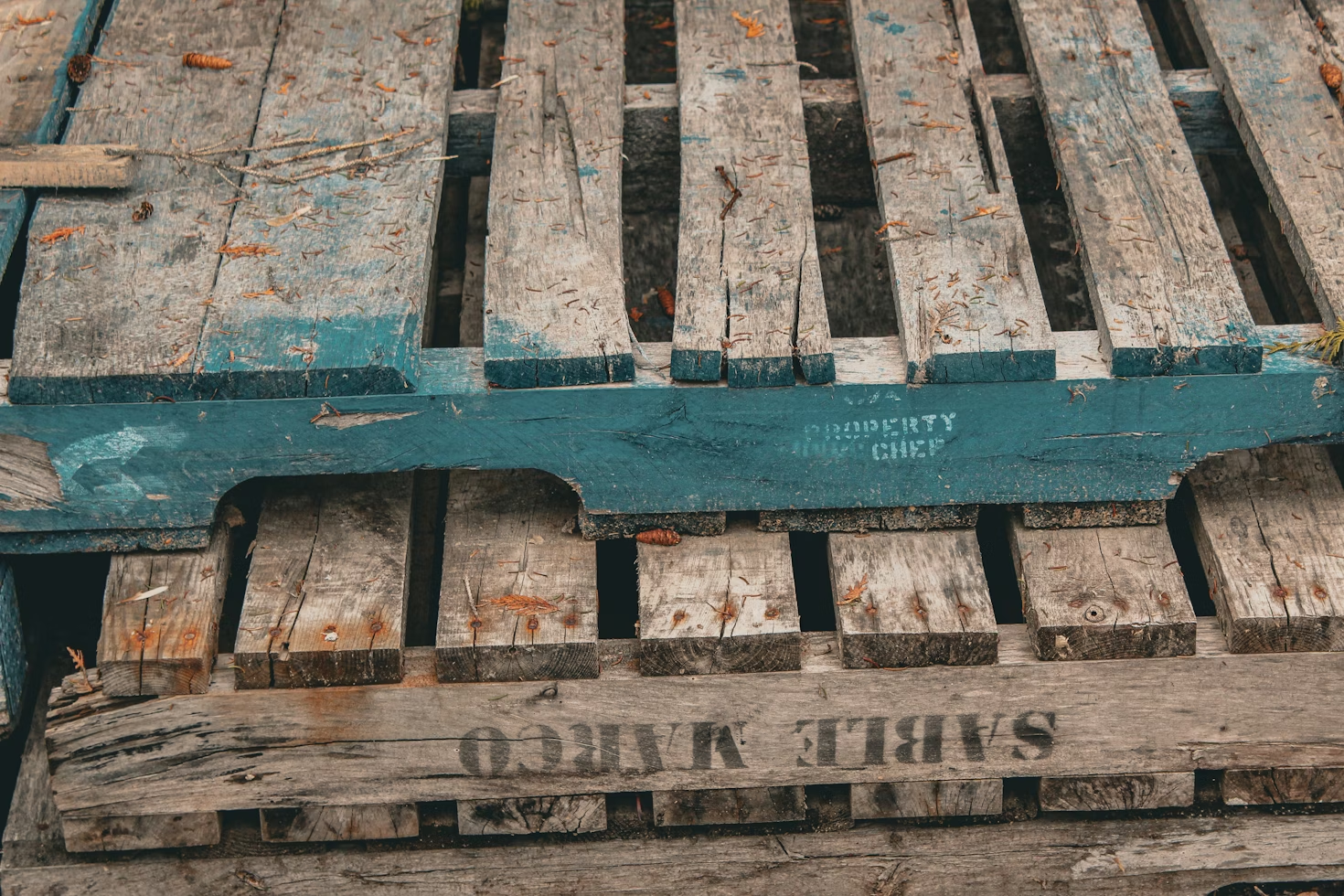
In the vast world of logistics and freight transport, wooden pallets are undisputed protagonists. They form the foundation upon which countless products rest, facilitating their movement by land, sea, and air. But have you ever wondered how long a wooden pallet can actually last? The wooden pallet lifespan isn’t as simple as a fixed number — it depends on several key factors, including the pallet type, usage intensity, and the maintenance it receives.
This article breaks down the variables that decide wooden pallet lifespan, compares the two dominant standards (American GMA and European EPAL), and explains why wood remains the preferred material for industrial logistics despite the existence of plastic and metal alternatives.
Factors that decide wooden pallet lifespan
A pallet’s service life is affected by five main variables: the quality of the wood, the pallet’s design, the weight of the load it carries, the frequency of use, and the environmental conditions (humidity, temperature, exposure to outdoor elements) under which it operates. A pallet used sporadically in a dry warehouse will far outlast a pallet handled daily in a humid loading dock — even if both started identical at production.
Lumber moisture at the time of nailing matters too. Pallets built from properly dried lumber (14-19 percent moisture) reach their full structural potential. Pallets built from wet lumber lose nail-holding strength as they dry in service, shortening their effective life. Our companion article on lumber moisture and pallet nail-holding explains why this single variable affects pallet quality more than producers usually credit.
American Pallets and Europalets: the two dominant standards
Among the wide variety of pallets, wooden ones — especially the American pallet and the Europalet — are the most widespread and versatile. Their design and dimensions make them ideal for a wide variety of industries.
American Pallet (or GMA Pallet): With its dimensions of 48 × 40 inches (1219 × 1016 mm), it’s the standard in North America and much of Latin America. Its robustness makes it ideal for transporting heavy and bulky goods. A well-constructed and handled American pallet can have an average lifespan of between 3 and 10 years, or even more if properly maintained and used in optimal conditions. A pallet that regularly transports cement bags in a closed loop between a factory and a distribution center might need repair or replacement every few years, while one used to store light products in a warehouse could last a decade.
Europalet (or EPAL Pallet): Measuring 1200 × 800 mm, the EPAL standard is the dominant European format. Its use has spread globally thanks to compatibility with European transport systems. Europalets are known for their standardized design and their ability to be efficiently repaired and reused. Their durability is comparable to the American pallet, also reaching between 3 and 10 years with proper use and maintenance. A Europalet in an international pharmaceutical product shipping cycle benefits from certified repair networks that ensure uninterrupted supply chains.
For both types, durability is maximized when pallets are handled correctly with forklifts, stored in suitable conditions, and repaired when they show minor damage.
How to extend wooden pallet lifespan
Beyond the inherent quality of construction, three operational practices significantly extend pallet service life:
Proper handling. Most pallet damage comes from forklift mishandling — drivers who push pallets sideways, hit them with the mast, or lift from the wrong side. Operator training cuts handling-related damage by 60-80 percent and typically pays back within a single quarter through reduced replacement costs.
Indoor or covered storage. Pallets exposed to rain and humidity absorb moisture, swell, and weaken at the fasteners. Even basic covered storage extends service life by years compared to outdoor exposure. The marginal cost of a roof is small compared to the cost of premature pallet replacement.
Scheduled inspection and repair. Routine inspection catches cracked stringers, loose nails, and split deck boards before they become catastrophic failures. A pallet repaired in time can serve another 2-5 years; the same pallet, abandoned after a single defect, ends up as scrap.
Advantages of wooden pallets over other materials
Despite the existence of pallets made from plastic, metal or composite materials, wood remains the preferred option due to its numerous advantages:
- Cost-effectiveness: Wooden pallets are typically 30 to 70 percent cheaper than plastic or metal equivalents at purchase, and the gap widens further when total cost of ownership is calculated.
- Repairability: Unlike other materials that often require complete replacement when damaged, wooden pallets are easily repairable. A broken board or damaged block can be individually replaced, significantly extending the pallet’s lifespan and reducing long-term costs.
- Sustainability and Recyclability: Wood is a renewable resource. Wooden pallets, once they reach the end of their useful life, can be recycled to make new wood products, chipped for biomass or compost, or even used as firewood. This reduces the environmental impact compared to plastic or metal, which require more complex and energy-intensive recycling processes.
- Strength and Rigidity: Wood offers an excellent strength-to-weight ratio. Wooden pallets are capable of supporting heavy loads and distributing them evenly, providing a stable base for transport.
- Natural Friction: The wooden surface offers natural friction that helps stabilize loads, reducing the risk of slippage during transport.
The economics of wooden pallet lifespan
For producers and end-users, the economics of pallet lifespan come down to total cost per use cycle, not unit purchase price. A €5 wooden pallet that completes 200 use cycles over its service life costs €0.025 per cycle. A €25 plastic pallet that completes 1,000 cycles costs €0.025 per cycle too — but only if it actually reaches 1,000 cycles in service, which depends on handling discipline that wooden pallets are more forgiving about.
Producers shipping to markets that recycle and return pallets see better economics from durable, repairable wooden pallets. Producers shipping one-way to markets that scrap pallets at destination usually find that simpler, lower-cost wooden builds win on cost-per-trip.
For broader operational topics, see our companion articles on benefits of wooden pallets and pallet line bottlenecks.
How we can help
At Global Wood Machines we work with pallet producers across Europe, North America and the Middle East to supply the equipment that builds pallets with the longest possible service life — calibrated nailing heads, quality-controlled feeders, and the systems that make consistent lumber-moisture management routine. Browse our pallet machinery catalogue for relevant equipment.
If you are reviewing your pallet specification or production line, get in touch with us — share your customer profile and we will identify the equipment configuration that maximises wooden pallet lifespan in your operation.